
Professional Activities
Professional Activities › Women Organizing in China
Women Organizing in China
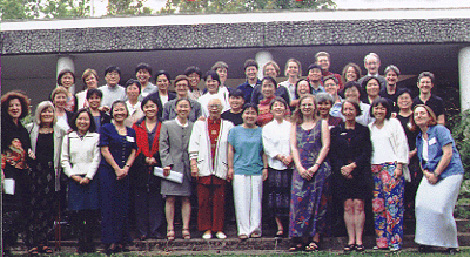
Oxford University, July 12-16, 1999
"Women Organizing in China" was held at the Wolfson College, Oxford University, England, July 12-16, 1999. An innovative feature of the workshop is the bringing together of multiple voices; those of indigenous and international feminist theoreticians as well as Chinese activists.
Historically in China, as elsewhere, there have always been women who have acted on an individual basis or organized collectively in opposition to gender and other inequalities. In the early years of the People’s Republic of China, women were collectively organized from a diverse group of women’s organizations into one officially sanctioned organization known as the All-China Women’s Federation (ACWF).
This organizing of women from above by the Communist Party took place as part of the Party’s commitment to gender equality.
The aim was also to ensure women’s support of Party policy. As contradictory effects of the economic reforms initiated in 1978 began to be felt with women shouldering in a disproportionate share of the burden of economic transition and due to simultaneous political relaxation, women have organized from below in women’s studies groups, social welfare organizations, professional organizations, informal groups and within the framework of their religion.
Thus, during the past fifteen years, the context of women organizing in China has begun to change from a state-centered, hegemonic to a multi-centered, heterogeneous framework.
The aim of the workshop was to engage in an empirical inquiry and theoretical analysis of women organizing in the PRC. The term women organizing had been chosen to include, first, organizing of women by others as well as women organizing on their own initiative and, second, different types of organizing both within and outside formal organizations as well as networks that cut across organizations.
The scope of women as organizers addressed by the workshop included the ACWF and other party/state institutions, the many new forms of collective action that had emerged in recent years going beyond institutional organization to include any form of collective action by women.
The workshop addressed economic, political, social, and cultural aspects of women organizing and also critically assessed the role of international funding agencies in influencing the nature and scope of women’s projects. Its objective was to:
- situate Chinese women organizing in the context of China’s current reforms;
- analyze opportunities and structural obstacles faced by women organizing;
- analyze strategies and practices of women organizing; and
- challenge stereotypical images of Chinese women as blind, passive victims of the CCP state and patriarchal tradition and question the usefulness of the application of dominant western civil society approaches with their focus on an oppositional relationship to the party/state to understanding the cultural context of women organizing in China.
The workshop was co-sponsored by the Institute for Chinese Studies and Centre for Cross-Cultural Research on Women, Oxford University. The Universities’ China Committee (UK), Sino-British Fellowship Trust, Great Britain-China Centre, Institute for Chinese Studies (Oxford University), and Ford Foundation, Reuter Foundation, and British Academy have provided funding for the event.
Organizers
Ping-Chun Hsiung
Sociology, University of Toronto at Scarborough College
Maria Jaschok
Centre for Cross-Cultural Research on Women, Oxford University
Cecilia Milwertz
Institute for Chinese Studies, Oxford University
Workshop Presenters
Elisabeth Croll, Jin Yihong, & Liu Bohong (Opening remarks)
Naihua Zhang, "NGO, National Policy Machinery, and the All-China Women’s Federation: Renegotiating Space and Position in Between Women and the State in Post- Mao China"
Xie Lihua, "How the Women’s Federation is Facing the Challenges of Market Economy"
Ma Yanjun, "Progress of the All-China Women’s Federation since the Inception of the Open and Reform Policy" (in absentia).
Irene Tong, "What do They Teach at Women’s Cadre Schools? An Outsider’s Perspective."
Guo Jianmei, "The Emergence and Development of Chinese Women’s Organization: A Case Study of the Women’s Legal Services Center, Peking University."
Jin Yihong, "Women Organizing: Future Trends and Current Challenges."
Astrid Lipinsky, "Reinventing the Grassroots: Structure and Organization of Fulian Work in Rural Hebei."
Han Henan, "Network, Reputation, and Professional Approach: A Case Study of the Changwen Women’s Federation."
Liu Bohong, "A Preliminary Study on Women’s Studies Organization in Contemporary China."
Fang Lian, "The Roles of Women’s Studies Program in Higher Education in Rural Development."
Liu Guanghua, "It’s all for the Sake of Women’s Psychological Health: A Case Study of the Huaguang Women’s College."
Sharon Wesoky, "Symbiotic Discourses and the Contemporary Chinese Women’s Movement."
Marianne Hester, "Organizing against Violence against Women in China."
Huang Yan, "Women Organized and Getting Truly Liberated by Relying All on Their Own Efforts: A Case Study of Wei Ling and her Sunshine Lunch Service for Schoolchildren."
Min Dongchao, "The Continuing Process: Translation of the Words ‘Feminism’ and ‘Gender’ into Chinese."
Ge Youli and Susie Jolly, "East Meets West Feminist Translation Group."
Maxine, "Lesbian and Gay Beeper Hotline."
Michaela Raab, Dagmar Wohlert, Niu Caixia, and Sofia Ericsson (Donor organizing roundtable)
Kimberley Manning, "The Ties that Bind: Gender and Guanxi in Women’s Organizing."
Zhu Li, "Economy in Mosques and Temples under Women Management."
Shui Jinjun, "Comparative study on Characteristics Featured in the Development of Christian (Protestant) and Islamic Women’s Organizations in Central Region of China."
Wang Xingjuan, "Social Change in China: The Roles and Development of a Chinese Non-Governmental Organization."
Guo Yanqiu, "Woman’s Mass-Media Network in China."
Gao Xiaoxian, "The Space and Strategies of Women’s Groups in China: A Case Study."
Delia Davin and Du Fangqin (Concluding remarks).